
R13 · 베터리얼 CNT 사용 · 회사 확인Betterial CNT use confirmed by company

리튬–황 전지에서 다공성 탄소의 기공과 연결 통로 설계Designing carbon cages and connecting windows for lithium–sulfur batteries

리튬–황 전지에서는 폴리설파이드가 이동할 통로와 이를 붙잡는 표면이 모두 중요합니다. 연구진은 인산을 이용해 다공성 탄소의 두 특성을 조절했습니다.Lithium–sulfur electrodes need pathways for polysulfide transport and surfaces that can retain those species. This study used phosphoric acid to control both features of a porous carbon host.

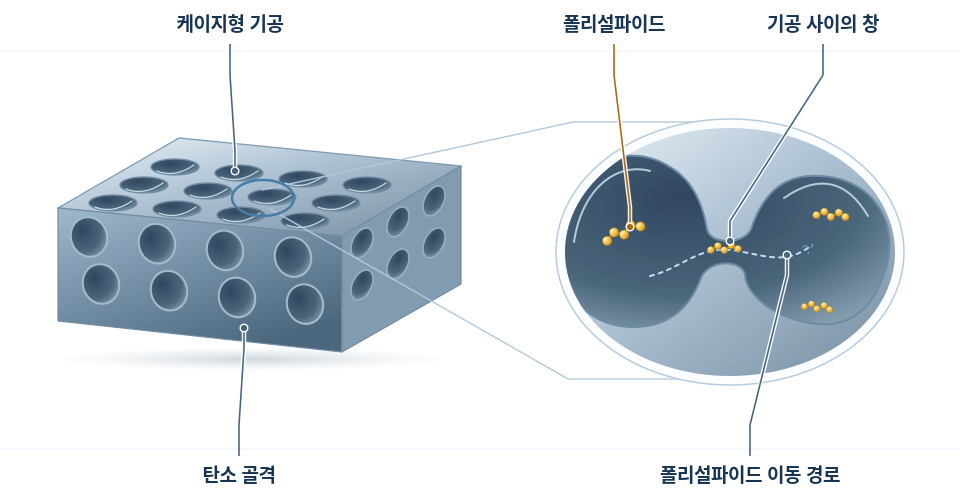
탄소 골격, 기공과 창, 폴리설파이드 및 이동 경로
다공성 탄소의 기공과 창Cages and windows in porous carbon도식 크게 보기Enlarge illustration

탄소 골격 내부의 공간과 인접 기공을 연결하는 창을 나타낸 개념도입니다. 통로 크기와 표면 작용기가 폴리설파이드의 이동 및 흡착에 관여합니다.Cavities and connecting windows form a network within the carbon host. Window size and surface functional groups influence polysulfide transport and adsorption.

인산 배합에 따른 기공과 연결 통로 크기

900 °C에서 인산/자당 몰비를 높였을 때의 양 끝값입니다. 아래 용량 유지율은 400 °C에서 제조한 별도 탄소 시료로 시험한 결과입니다.

기공 지름

  • 낮은 인산 비율13.1 nm
  • 높은 인산 비율16.6 nm

기공 사이 창 크기

  • 낮은 인산 비율7.3 nm
  • 높은 인산 비율9.8 nm
400 °C 시료 · 300사이클 용량 유지율
82.3 %
측정 근거 보기

연구 설계Study design

인산은 당 전구체의 탈수를 촉진하고, 실리카와 탄소의 계면에서 기공과 기공 사이 통로의 크기를 조절했습니다. 연구진은 탄화 온도와 인산 배합을 바꿔 구조, 폴리설파이드 흡착 및 전지 성능을 비교했습니다.Phosphoric acid promoted dehydration of the sugar precursor and modified pore and window sizes at the silica–carbon interface. The team varied acid content and carbonization temperature and compared pore structure, polysulfide adsorption and battery performance.

연구 결과Study findings

900 °C 조건에서 인산 비율을 높이자 기공 지름은 13.1에서 16.6 nm로, 연결 통로는 7.3에서 9.8 nm로 커졌습니다. 400 °C에서 합성한 작용기 풍부 탄소를 적용한 전지는 300사이클 후 초기 용량의 82.3%를 유지했습니다.At 900 °C, increasing the acid ratio enlarged the pore diameter from 13.1 to 16.6 nm and the window size from 7.3 to 9.8 nm. A cell using functionalized carbon prepared at 400 °C retained 82.3% of its initial capacity after 300 cycles.

소재 적용과 해석 범위Material use and interpretation

베터리얼은 이 연구에 자사 CNT가 사용되었음을 확인했습니다. 논문이 비교한 기공 크기와 표면 작용기는 합성한 다공성 탄소의 특성입니다.Betterial confirms that its CNTs were used in the study. The reported pore dimensions and surface functional groups characterize the synthesized mesoporous carbon host.

이 소재를 구매하고 싶으신가요?

누르면 이 노트의 번호와 제목이 입력된 메일이 열립니다.

contact@betterial.io