
연구 설계Study design
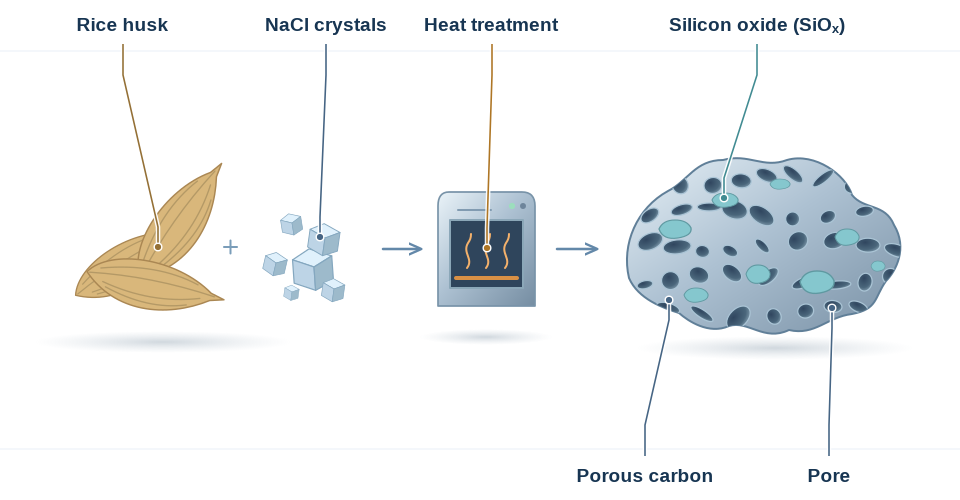
왕겨 분말과 작은 염화나트륨 결정을 혼합해 열처리했습니다. 소금은 탄소 기공이 발달하고 비정질 실리카가 형성되는 과정에 관여합니다. 연구진은 소금 사용 여부와 결정 크기에 따른 복합체의 전기화학적 거동을 비교했습니다.Milled rice husk was heat-treated with small sodium chloride crystals. The salt helped develop porosity in the carbon and promoted the formation of amorphous silica. The study compared how salt addition and crystal size affected the composite anodes.
연구 결과Study findings
같은 공정을 보고한 저자진의 EcoMat 논문에서 미세 NaCl을 사용한 전극은 0.05 A/g에서 첫 충전 용량 422.05 mAh/g, 첫 방전 용량 915.93 mAh/g를 보였습니다. 소금 없이 만든 비교 전극보다 고율 특성도 향상됐습니다.In the authors’ companion EcoMat paper, the electrode prepared with submicron NaCl delivered first-cycle charge and discharge capacities of 422.05 and 915.93 mAh/g, respectively, at 0.05 A/g. It also showed better rate capability than the salt-free comparison electrode.
소재 적용과 해석 범위Material use and interpretation
베터리얼은 학위논문 연구에서 자사 CNT가 사용되었음을 확인했습니다. CNT로 실리콘을 감싼 2장과 CNT·카본블랙을 함께 사용한 3장은 R02과 R03에서 다룹니다. 4장의 핵심은 왕겨 유래 복합 활물질이며, 동반 논문에 기재된 시험 전극 도전재는 Super P C65입니다.Betterial confirms CNT use in the dissertation research. Chapters 2 and 3 correspond to the silicon-wrapping and hybrid-network studies in R02 and R03. Chapter 4 focuses on the rice-husk-derived active composite. The companion paper lists Super P C65 as the conductive additive in the tested electrodes.